Missing
The form fired, the lead landed, and the consent language never traveled with it. You have a phone number and a hope.
Your workflows text in seconds and your AI agents call back in four. ConsentVault proves every one of those contacts was agreed to, in the exact words, at the exact moment, sealed by someone outside your company.
What one “no” costs
One workflow texts 2,000 people it cannot prove consent for. That is 2,000 × $500 = $1,000,000. One list, one bad Tuesday. And when a plaintiff says “I never agreed,” the burden of proof sits with the company that sent the message.
The problem
Every team believes it has consent. Very few can prove it in the form a court accepts.
The form fired, the lead landed, and the consent language never traveled with it. You have a phone number and a hope.
Consent lives in an editable field. A rep, an import or a vendor changes it and nothing records that they did. In discovery, mutable reads as made up.
The person agreed to hear from one brand and a different brand called. Or the disclosure changed in March and nobody kept February’s version.
The person said stop, by text, voicemail, email or to a rep, and the system that dials never heard it.
If your consent proof is a screenshot someone took last week, you do not have consent proof. You have a screenshot.
The odometer problem
Buying a used car, you never trust the odometer by itself. You trust the title history: every sale, the mileage written at that moment, stamped by a party with no stake in the number. ConsentVault is the title history.
How it works
A register earns the word “outside” when it has all five. Four out of five is a nicer CRM.
Nothing is updated or deleted. A correction is a new row that points at the old one, enforced in the database, not in a policy document.
Each row carries the fingerprint of the row before it. Change any old row and every link after it breaks.
The chain is signed by an RFC 3161 timestamp authority you do not control. Only a fingerprint leaves your systems, never the person.
Every seal names the exact fields it covered, so adding a column next year never makes old evidence read as tampered.
Every link and every seal is re-checked every day and fails loudly, by name, the same day. A seal nobody checks is a seal nobody can testify to.
Try it: click any block to edit its record, then watch what the chain says.
The lifecycle
Write the event at the click, from the server. The exact disclosure is stored once, versioned, and fingerprinted on the row. Unchecked box by default, sellers named in plain words.
Each row is chained on insert and the chain is sealed by an outside timestamp authority on a schedule. Receipts are kept where a single admin cannot delete them.
Before any call, text, voicemail drop or AI conversation, the sender asks one question: is there an unrevoked consent for this person, this channel, this seller, right now?
Every place a person can say stop writes a revocation to the same register. Target minutes, not the ten business days the rule allows.
One person, one evidence pack: every event in order, the words behind each fingerprint, the seal receipts and every gate decision.
At least four years past the last contact. Third-party session certificates expire unless claimed; ConsentVault keeps your own copy.
AI agents
A human rep makes one bad call. An AI agent makes four thousand before lunch. The gate sits in front of every agent you run.
The agent cannot start a conversation without a fresh gate decision naming the consent it relies on. If the register is unreachable, the answer is no. A gate that fails open is not a gate.
Consent to calls is not automatically consent to an AI voice. It is captured explicitly, named in the disclosure, and announced at the start of the call.
An agent can record that a person said stop. It can never create or restore a consent. Grants come from capture, with their own credentials.
“Take me off your list.” “Don’t call me again.” Transcripts are scanned for revocation language and the stop is written before the call ends.
Prompt injection through a form field
ControlForm fields are untrusted data; the model that reads them has no tool that can change consent.
Hallucinated consent
ControlConsent is a lookup in the register, never a model’s judgment of a friendly transcript.
PII sprawl
ControlKeyed fingerprints in the ledger; the raw number lives in one governed store.
Shadow tools
ControlA written data-tier rule for what may enter which AI tool, and an approved-processor list.
The rules keep moving
The FCC rules AI-generated voices are “artificial” voices. An AI voice agent calling for marketing needs prior express written consent.
The Eleventh Circuit vacates the one-to-one consent rule. The seller list on your form is still your evidence.
Consumers can revoke by any reasonable means. STOP, QUIT, END, REVOKE, OPT OUT, CANCEL and UNSUBSCRIBE all count. Ten business days to honor.
McLaughlin v. McKesson: courts no longer owe deference to the FCC’s reading. Agency guidance is no longer a shield. Your evidence is.
Texas SB 140 treats marketing texts as telephone solicitation and opens a private right of action.
The FCC replaces revoke-all. Informational messages can be opted out by category. Marketing got no relief: one opt-out stops all telemarketing, affiliates included.
One build, two exams
If your AI touches consumers, the consent register is a large share of what an AI management-system auditor asks for. Certification is a management-system audit, not a product badge: the auditor wants the rule, the owner, the evidence and the check that runs when nobody is looking.
The 10-minute proof drill
Pick one phone number you texted or dialed last month. Start a timer. Then answer these four:
Tick what you could produce in under ten minutes today.
You are at Level 0: Hope. ConsentVault is built to get you to Level 4.
Where ConsentVault fits
Session certificates such as TrustedForm or Jornaya record the session as an independent witness. They are not your system of record. ConsentVault claims and keeps the copy you rely on.
RFC 3161 timestamp authorities sign a fingerprint of your chain. Pennies per seal, and the person’s data never leaves.
The ledger, the gate and every stop path, owned by you, exportable by you, touching every system you send from. Never let the only copy of your evidence live in someone else’s account.
Your consent record is an odometer. If you can roll it back, so can the jury’s imagination.
For growth teams
For compliance and counsel

Who builds it
Fractional Chief AI Officer · The Innovative Native
Twenty years in growth marketing, now building the infrastructure underneath it. ConsentVault started as the consent register behind a real lead-gen operation, built after the hard way taught the five properties. One of those lessons: I added one column, and the next morning my own daily check called 203 sealed records tampered. Not one had changed. Every seal now names its columns. Nothing reads as tampered unless it was.
“There is a difference between using AI and having AI run your business. The difference is the evidence.”
Frequently asked
An append-only ledger of consent and revocation events, where each event is hash-chained to the one before it and sealed by an independent party, so the record can be verified by someone who does not trust the company that keeps it.
ConsentVault is in early access. The method runs today on a working consent register behind a real lead-gen operation; we are hardening it and packaging it for other teams now. Join early access and you will hear first when onboarding opens.
No. Session certificates are witnesses, and good ones. ConsentVault is the register: it keeps your own copy of what you rely on, adds every stop from every channel to the same chain, and gates every send against it.
No. Only a fingerprint (a SHA-256 hash) of the chain goes to the timestamp authority. The person’s phone number and email never leave.
AI voice is its own consent scope. The gate denies by default, agents can write stops but never grants, and every revocation phrase in a transcript is written to the register before the call ends.
The register is documented evidence for policy, ownership, data provenance, monitoring and third-party control for one of your highest-risk AI uses. It supports an audit; it is not a certification.
No. ConsentVault provides operations and direction behind decisions toward compliance. We are not legal counsel. Have your counsel review your disclosures and contact rules.
Early access
Join early access for ConsentVault. You also get the free field guide: the event schema, the five properties, the 10-minute drill and a 30-day build plan.
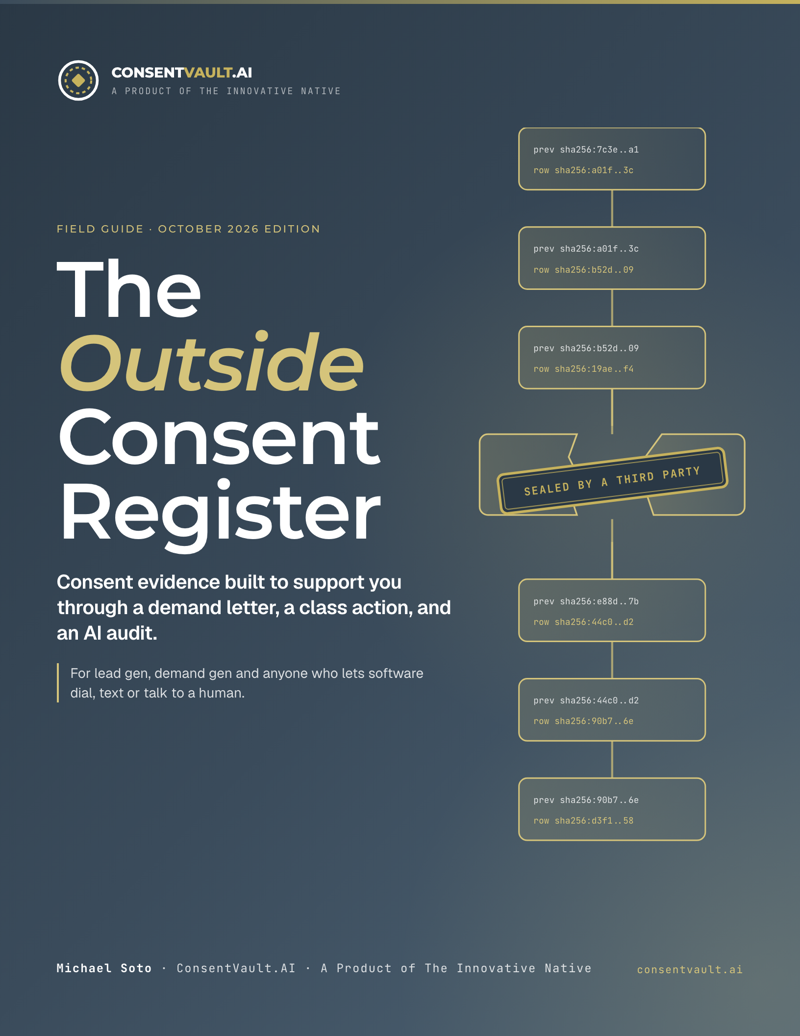 The Outside Consent Register